 Courtesy subject, Remaining image: Getty ImagesSave this storySave this story
More times than I can count (or care to) I’ve declared that, although I am zealous about every woman’s right to decide what, if anything, she wants to do to her face, I myself have deep roots firmly planted in the no-surgery camp. At 75, I’ve had plenty of time to think about it, weighing the pros and cons, giving full reign to my imagination about the delicate intricacies (and gory details) of invasive procedures, recovery processes, and eventual outcomes.
All that thinking has only strengthened my conviction that learning to love your face without objectification is a powerful way to counteract the damaging and distressing messages from a beauty culture that prizes youthfulness and hypersexuality. I could say without ambivalence that I’m not a candidate for elective surgery. Until now.
It isn’t wrinkles or sagging per se that have changed my outlook. I love an old face. (Including my own.) The problem is with a particular manifestation of aging, which I’ve described this way: The corners of our mouths droop, making us look impatient or fretful when we’re not—intensifying resting bitch face (RBF) if we’re already prone to it. That situation is exacerbated by an unfortunate combination of gravity, bone loss, and reduced soft tissue volume.
It isn’t wrinkles or sagging per se that have changed my outlook. I love an old face. (Including my own.)
Neuromodulator injections and filler can help lift the corners of your mouth, but I’m not into injections in that area, because there’s a very slight risk of losing the ability to enunthiate thertain conthonanths.
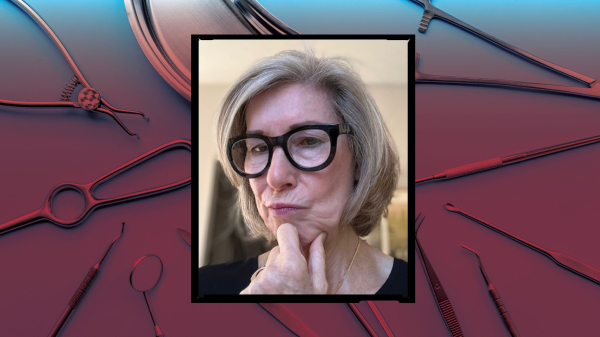
Because of this inevitable loss of structural support, the area around my mouth seems to have set itself into something that looks exactly like disdain. Disdain! The emotion I am least likely to succumb to, ever! Interestingly, it’s not even the look on my face that disturbs me; it’s the consequences of the look. Because unless I’m smiling, someone who catches me glancing at them would most likely believe not only that I think they’re hardly worthy of my attention, but that I am suffused with contempt.
So not me. So very much not me.
I might’ve anticipated this situation when I noticed that my 93-year-old mother, a remarkably cheerful woman in her oldest age, often seemed to look very discontented. What was wrong, dear Mom? “What? Nothing!” she’d declare, her face suddenly blooming into a smile. “I was just thinking of…your father, my grandchildren, the delicious soup I had last night…” While any number of pleasant memories were playing in her head, you might’ve thought, looking at her face, that she’d just fallen into an open grave.
Unless I’m smiling, someone who catches me glancing at them would most likely believe that I am suffused with contempt.
Lest you think this preoccupation with my newly unappealing expression is vain or self-involved, actually, now that I think about it, it is (so shoot me). But there’s more to it. Facial expressions are one of the most important forms of non-verbal communication, according to an editorial in the academic journal Frontiers in Psychology, citing many studies. Mimicking facial expressions is a way of sharing emotions, for example. Being aware of that, I’ve always loved noticing how, in conversation, someone will raise her eyebrows as I raise mine, or reflexively smile at my own smile. The feeling that generates? We’re in this together.
Among other things, facial expression can also influence decision-making: A happy expression can induce more willingness in an observer to take a risk. I thought of the influence of facial expression the other day as I listened to fashion writer Amy O’Dell interviewing Sophie Gilbert, who writes often about culture and women’s issues for The Atlantic. Referring to Kim Kardashian’s neutral stare in the TV series All’s Fair and other media outlets, Gilbert says, “She has just become this avatar of immobile, provocative expressionlessness for women. She’s giving nothing.” O’Dell and Gilbert go on to mention several examples of other celebrities’ blank stares.
I don’t know about you, but what that blank stare says to me is mean girl. In fact, I remember very well clocking it on certain of my 7th grade classmates. What they were communicating—in their case intentionally—was disinterest, judgment, and subtle hostility. All of this was evident from their lack of micro-expressions, like the slight lifting of the brows that opens the eyes and softens the face.

Drawing a blank: Hailey Bieber, Zoë Kravitz, Charli XCX, and Rosé at the Saint Laurent show in Paris in September.
Getty Images
This lack of expression, zombie-like at its most extreme, can, of course, be the result of too much neurotoxin injected into the facial muscles. It’s the reason I never do Botox or any of its ilk around my eyes to eliminate crows’ feet. I’ve written about why: I have strong feelings about crow’s feet: I like them. Personally, I think crow’s feet are the least unbeautiful of wrinkles; you get them from squinting, sure, but also from a fully engaged smile—called the Duchenne—in which the corners of your eyes get crinkly. It lets people know you are genuinely happy. That’s nice, right? Better: When people respond to your happiness, it precipitates a neural loop that can make you feel even happier. (For the record, I do get neurotoxin injected between my brows—because my frown lines, on the other hand, do not precipitate a happy neural loop.)
Facial expressions are one of the most important forms of non-verbal communication.
Am I saying crow’s feet are good for you? Kind of. And scientists would agree: Studies of yearbook pictures, politicians’ headshots, and dating profile photos show that deep crow’s-feet are good predictors of lower divorce rates, election victories, and how wealthy people think you are, respectively.
And they’re not just good for you, but good for the people who might care about you and your well-being. I happen to have many crow’s feet. A murder of them. Complementing them, a couple of pretty prominent under-eye bags. They may make me sometimes look tired when I’m not. But they don’t influence other people’s perception in a way that suggests I might be disdainful of them, or worse, contemptuous.
That’s what I can’t abide, and what has finally uprooted me from my comfortable position as a no-facial-surgery constituent. I’m not sure what exactly can be done to ameliorate my situation, but I think it might be something called a “lip lift,” which definitely involves a scalpel. For now, I’m voting for discovery. All this is just to say, when it comes to our decisions about aesthetic choices, we have the option to change our minds. Let’s not be judgy about it. Unless you’re living under a rock, you’ve probably already been confronted by the finger-wagging arguments against aesthetic manipulation: it’s misogynistic, patriarchal, anti-feminist, destructive to your physical and spiritual self. I believe that, yes, it can be. Also, that sometimes, it is not.
